
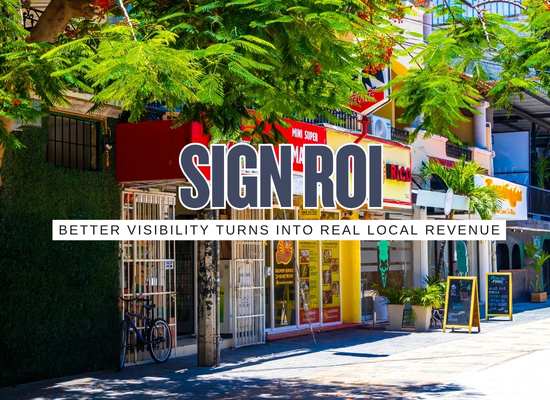

The hidden return behind a better business sign
A stronger sign can do more than identify a storefront. It can turn passing traffic into calls, walk-ins, map searches, referrals, and repeat recognition. For many local businesses, the sign is the one marketing asset customers see before they ever click, call, park, or step inside.
The sign is part of the sales system
A business sign is often treated like a construction detail. In practice, it behaves more like a permanent local advertisement, wayfinding tool, trust signal, and brand reminder.
A paid ad may run for a week. A social post may fade in a day. A mailer may be thrown away before it is read. A business sign keeps showing up in the same market, to the same local audience, around the same streets and decision points where customers are already moving.
The real value is not only the first glance
Many customers do not act the first time they see a business. They may pass the sign for weeks, notice the name again in search results, hear it from a neighbor, then finally call or stop in. That delayed action still belongs partly to the sign because the sign helped create familiarity.
The return is usually spread across multiple behaviors. A better sign can reduce confusion, increase confidence, improve the storefront’s perceived quality, and make future marketing easier because the business already feels familiar.
Signage creates several kinds of return at the same time
The strongest signage investments are not limited to one result. They create a chain reaction across local awareness, customer confidence, and physical traffic.
The four hidden ROI channels
When a business upgrades signage, the return does not always show up as one obvious number. It often appears through several small improvements that compound over time.
Calls from nearby demand
A visible sign can trigger calls from people who are already nearby and already need the service. This is especially valuable for clinics, repair shops, restaurants, contractors, salons, professional offices, gyms, and local service businesses.
Walk-ins from faster decisions
Customers often make quick choices from the road, sidewalk, or parking lot. If the sign clearly communicates the business and looks professional, it can help the customer choose before they keep driving.
Trust before contact
A faded, cluttered, or poorly lit sign can make a business feel temporary. A stronger sign helps the outside of the business match the quality of the service inside.
Recognition that builds over time
Local familiarity has value. A customer may not need the business today, but repeated exposure makes the business easier to recall when the need appears later.
The road test separates strong signs from expensive decorations
A sign can look beautiful on a computer screen and still fail in the real world. Local signs must work under imperfect conditions: moving traffic, harsh sun, evening glare, rain, parked vehicles, landscaping, poles, competing signs, and customers with only a few seconds to process the message.
| Performance Factor | Business Effect | Common Weak Spot | Stronger Direction |
|---|---|---|---|
| Letter size | Improves readability from distance | Letters designed for a screen instead of a street | Scale the sign around real viewing distance and traffic speed |
| Contrast | Helps customers process the sign faster | Low contrast colors, thin strokes, busy backgrounds | Use bold separation between text, logo, and background |
| Lighting | Extends visibility into evening and poor weather | Uneven illumination, dim cabinets, dark storefronts | Match illumination to the site, brand, and surrounding light conditions |
| Placement | Reduces missed turns and location confusion | Blocked sightlines from trees, poles, vehicles, or building angles | Review the sign from traffic lanes, entries, sidewalks, and parking spots |
| Message clarity | Tells people the business category quickly | Logo only, unclear name, too many words | Use a simple descriptor if the name does not explain the service |
| Condition | Protects perceived quality | Faded vinyl, cracked panels, missing letters, outdated graphics | Refresh before the sign starts signaling neglect |
Practical test: Drive past the business at normal traffic speed and ask whether a first-time customer could read the name, understand the category, know where to turn, and feel confident enough to stop. If any answer is weak, the sign is probably leaving money on the road.
Signage value changes by business model
The same sign strategy does not fit every business. A restaurant needs fast recognition and appetite appeal. A medical office needs reassurance and clear wayfinding. A contractor may get more return from vehicle graphics and jobsite signs than from a traditional storefront alone.
| Business Type | High-Value Signage | Primary Return | ROI Potential |
|---|---|---|---|
| Restaurants and cafes | Channel letters, window graphics, menu displays, monument panels | Impulse visits, repeat awareness, evening visibility | High |
| Medical and dental offices | Monument signs, suite signs, directional signs, lobby signs | Patient confidence, easier arrival, trust before appointment | High |
| Retail stores | Storefront signs, blade signs, window vinyl, seasonal displays | Walk-ins, product discovery, brand recall | High |
| Contractors and home services | Vehicle wraps, yard signs, shop signs, jobsite signs | Neighborhood exposure, referral support, repeated impressions | High |
| Law, finance, and professional offices | Dimensional letters, monument signs, directory signs, lobby signs | Credibility, client confidence, premium positioning | Medium |
| Shopping centers and plazas | Pylon panels, tenant signs, parking signs, directional signs | Tenant discovery, cleaner property identity, smoother traffic flow | Watch |
Simple signage ROI estimator
This worksheet helps a business think through the return without overcomplicating it. The goal is not perfect attribution. The goal is to connect the sign investment to the local actions it may influence.
| Input | Example | Your Number |
|---|---|---|
| Extra monthly calls tied to better visibility | 14 | |
| Percent of those calls that become customers | 30% | |
| Gross profit per new call-based customer | $225 | |
| Extra monthly walk-ins tied to the sign | 20 | |
| Percent of walk-ins that buy, book, or request a quote | 25% | |
| Gross profit per walk-in customer | $90 | |
| Estimated monthly recognition value | $200 |
Using those sample numbers, the sign could influence $1,395 in monthly gross profit before adding any long-term recognition value. Actual results vary by business type, location, offer, visibility, and sales process, but the exercise shows why signage should be judged as a revenue asset instead of a simple design expense.
The trust signal customers notice before they notice price
Customers make fast judgments. Before they read a review, compare a quote, or speak to the owner, they already have a feeling about the business. The sign helps create that feeling.
- A clean sign suggests the business pays attention to details.
- A readable sign suggests the business is easy to work with.
- A well-lit sign suggests the business is active and established.
- A consistent sign package suggests the brand is organized and professional.
- A neglected sign can quietly weaken trust before the customer ever walks inside.
This is especially important for businesses selling higher-trust services: healthcare, legal help, financial services, construction, automotive repair, property services, childcare, fitness, and professional consulting. The sign does not close the sale by itself, but it can make the first step feel safer.
The local recognition loop
Strong signage helps every other marketing channel work harder. It connects the physical business with the customer’s memory, online searches, referrals, and repeat trips through the area.
This loop is one reason a better sign can keep producing value even when the business is not actively running a campaign. The sign keeps the brand present in the same physical market the business depends on.
Signals that a business sign is underperforming
Some signs are technically installed but still weak as marketing assets. These signs may satisfy a lease or permit requirement, but they do not fully support customer action.
Customers say they had trouble finding the location
This often points to a visibility, placement, directional, or lighting issue. It may also mean the sign works from one angle but fails from the customer’s actual approach route.
The sign looks better up close than from the road
Small details, thin fonts, and low contrast can disappear at distance. A sign needs to be designed for real viewing conditions, not only for a close-up photo.
The business category is not obvious
If the name alone does not explain the service, customers may keep moving. A simple descriptor can help turn attention into understanding.
The sign makes the business feel smaller than it is
Old panels, faded colors, temporary banners, mismatched window graphics, or poor lighting can make a serious business look less established.
A practical 90-day measurement plan
A business does not need a complicated analytics system to measure signage impact. A few simple tracking habits can reveal whether the sign is supporting visibility, trust, and local action.
| Signal to Track | Simple Method | Useful Question |
|---|---|---|
| Phone calls | Track weekly call volume before and after the sign upgrade | Did local inquiry volume increase? |
| Walk-ins | Ask new visitors how they noticed the business | Are more customers mentioning the sign or location? |
| Map activity | Watch direction requests and profile interactions | Are more people trying to find or visit the business? |
| Branded searches | Monitor searches for the business name | Is local recognition increasing? |
| Customer comments | Listen for comments about the new exterior or easier visibility | Is the sign improving first impressions? |
| Sales conversations | Add a simple “How did you find us?” question | Is the sign influencing calls, visits, and referrals? |
The upgrade paths that usually make the biggest difference
Not every business needs a completely new sign package. Sometimes the best return comes from fixing the specific weak point that is costing attention.
- Improve readability first. Bigger letters, cleaner fonts, better spacing, and stronger contrast can create an immediate visibility gain.
- Add or improve lighting. Evening visibility can matter for restaurants, medical offices, gyms, retail, service businesses, and locations near commuter routes.
- Clean up the storefront system. A strong main sign can be weakened by cluttered windows, old decals, temporary posters, or mismatched door graphics.
- Use directional signs where customers hesitate. Parking lots, side entrances, suites, rear entrances, and multi-tenant properties often need more than one sign.
- Match materials to the business value. A premium service business should not look temporary from the outside. Dimensional letters, quality panels, and polished lobby signage can support stronger positioning.
- Extend the brand beyond the building. Vehicle graphics, jobsite signs, yard signs, banners, and interior signs can multiply recognition when used consistently.
Better signage removes friction from the customer journey
A strong business sign helps customers notice the location, understand the offer, trust the company, remember the brand, and take the next step. That makes signage more than a visual upgrade. For many local businesses, it is a long-term visibility asset sitting directly in front of the market they want to reach.